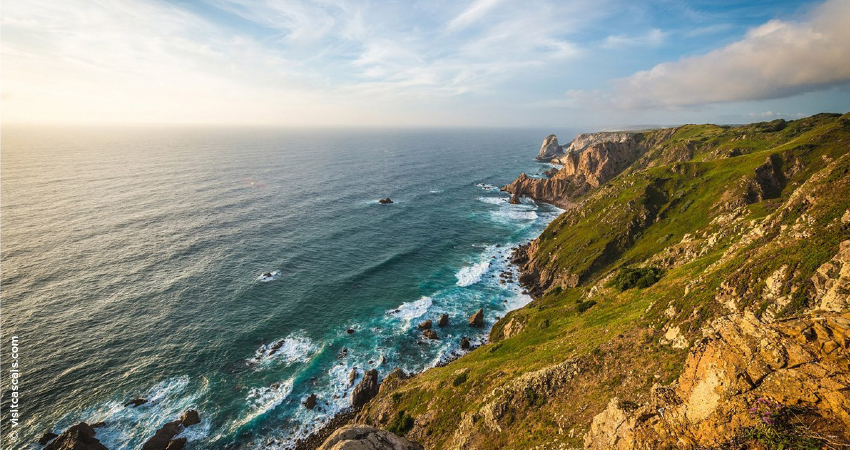
Father’s Day is celebrated annually on March 19. Turn this date into a unique and unforgettable experience for the whole family. How about setting off to discover the stunning landscapes that walks through the Sintra-Cascais and Arrábida Natural Parks have to offer? Get ready for an outdoor adventure that everyone will remember.
True natural treasures, Portugal’s Natural Parks offer visitors the perfect opportunity to explore the country’s genuine natural beauty through hiking trails, viewpoints with breathtaking vistas, and unique local flora and fauna. With a diversity of landscapes and ecosystems worth discovering, Portugal’s natural parks play an important role in environmental preservation and biodiversity conservation.
Our suggestions for Natural Parks to discover:
- Sintra-Cascais Natural Park
Created in March 1994 by Regulatory Decree No. 8/94, reclassifying its previous status as a Protected Landscape Area, the Sintra-Cascais Natural Park covers an area of 14,583 hectares. It spans the coastal strip from the Cascais Citadel to the mouth of the Falcão River, the Sintra mountains, and the agricultural area north of the Colares floodplains.
The preservation of these three major landscape units involves respecting the specific characteristics that individualize them and give them their beauty and power of attraction.
The Sintra mountains, long celebrated for their beauty, stand out as the unifying element of the group, highlighting their geomorphological interest and richness in terms of flora. Facing the ocean, the mountains distribute humidity according to the play of exposures; in certain landscape details, trees associated with a tangle of vines take on the appearance of a dense forest.
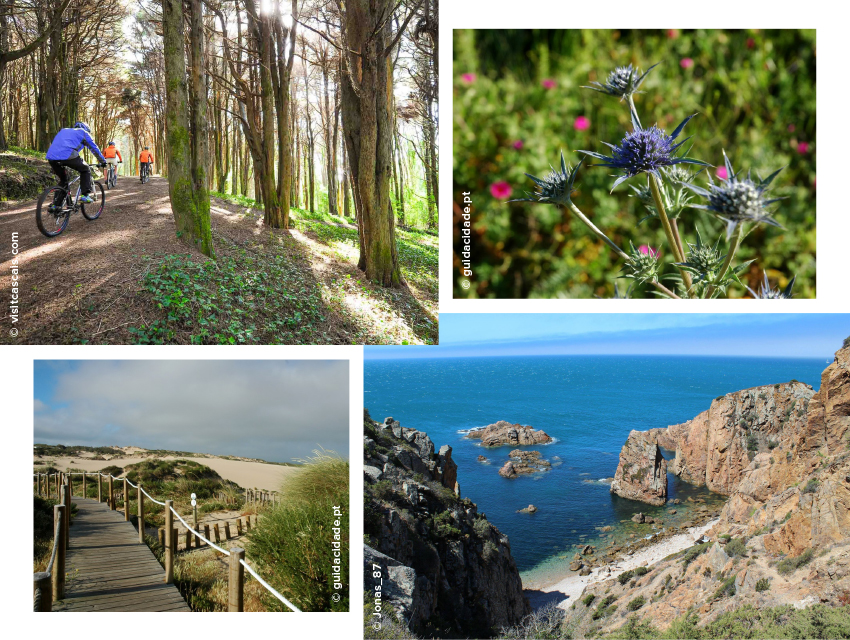
Here, adventure can be on your own with little risk, or by following the paths proposed by the Park, visiting sites such as the Convento dos Capuchos, a modest 16th-century friars’ shelter, or the Peninha Chapel, built on a high point near the coast from which a vast panorama can be seen.
The coastal strip, marked by a succession of low cliffs, dune areas, hidden sandy beaches, high limestone cliffs, reefs, and islets, is dominated by Cabo da Roca, Europe’s westernmost point. Its cliffs rise about a hundred meters above the ocean, providing grand landscapes where the boldest can obtain a certificate of presence at the Tourist Office as a souvenir of their visit.
An area of ancient human settlement, the agricultural land is divided by dry stone walls or live hedges of cane or reed that serve as a defense against strong sea winds.
In this Sintra-Cascais territory, where the presence of Man has been felt for a long time, the practice of nature conservation is associated with the idea of use—intelligent use. This means recognizing that any human activity must respect the limits imposed by the specificity of the natural environment, which is why the Sintra-Cascais Natural Park’s main objective is to safeguard natural and landscape resources, with a special focus on geological, geomorphological, floral, and faunal aspects.
Contacts
Cabo da Roca Tourist Office – Cabo da Roca – Azóia, 2705-001 Colares
T. +351 21 923 85 43 | Email: dtur.roca@cm-sintra.pt | https://visitsintra.travel
Headquarters: Quinta dos Plátanos – Av. Barão Almeida Santos, 10-12, 2710-525 Sintra
T. +351 21 924 72 00 | Email: pnsc@icnf.pt | www.natural.pt | www.natural.pt/en
- Arrábida Natural Park
Created in 1976 by Decree-Law No. 622 of July 28 (and later reclassified by Regulatory Decree No. 23/98 of October 14), the Arrábida Natural Park is located on the Setúbal Peninsula, covering an area of approximately 10,820 hectares distributed across the municipalities of Setúbal, Palmela, and Sesimbra. The Park also includes the “Professor Luís Saldanha Marine Park,” covering the marine area between Arrábida and Espichel. This natural park is also part of the European Network of Biogenetic Reserves (Council of Europe), classified as a CORINE biotype, and is a Site of Community Importance (SCI) – Arrábida/Espichel within the Natura 2000 Network. The fact that it is situated in a convergence zone of Atlantic and Mediterranean influences, and enjoyed relative protection during the last glaciations, has given this region a natural heritage of great importance combined with undeniable landscape value.
Created with the aim of preserving natural, historical, cultural, and socio-economic values in a region where Man and Nature live hand in hand, the Arrábida Natural Park owes its name to the Arrábida mountain range. This consists of three different axes: the first composed of small elevations around Sesimbra, the Risco and Arrábida mountains—the most majestic and imposing—and the hills between Outão and Setúbal; the second is formed by the S. Luís and Gaiteiros mountains, and the third by the Louro and S. Francisco mountains.
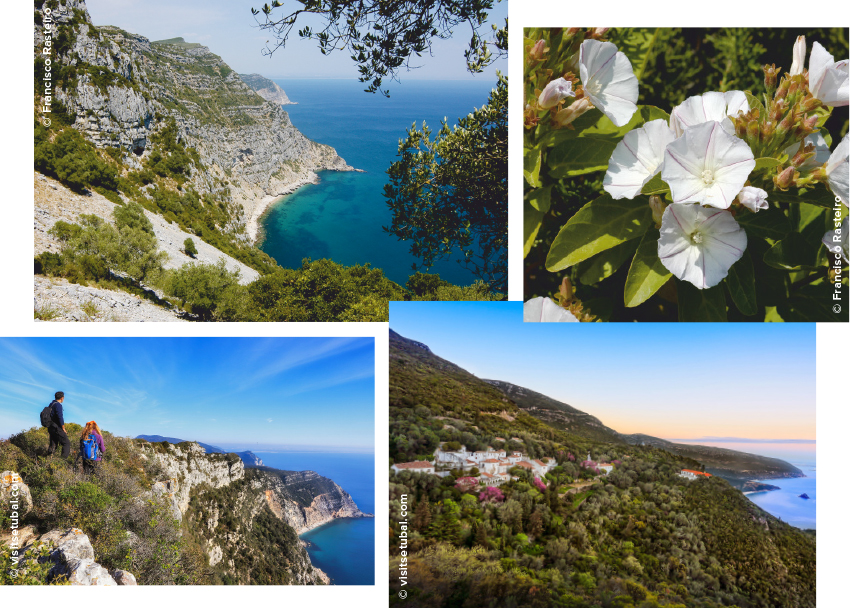
The Arrábida mountain range, as well as the vast plain surrounding it, possesses a great diversity of soils due to the varied composition of the rocky materials that form the bedrock. The vast majority of the soils are of sedimentary origin, although some eruptive intrusions appear, especially in the Sesimbra region. Quite rocky, the coastline is indented by small bays with white sand beaches that create a beautiful contrast, such as Ribeira do Cavalo Beach, Galapos Beach, Galapinhos Beach, and Portinho da Arrábida Beach.
As plant richness is one of the greatest attractions of the Arrábida Natural Park, its preservation is a priority; therefore, to keep it intact, access to some areas is only possible when accompanied by a Guide appointed by the Park Headquarters.
Contacts
Headquarters: Praça da República, 2900-587 Setúbal
T. +351 265 541 140
Delegation: Oceanographic Museum – Stª. Maria da Arrábida Fortress Portinho da Arrábida, 2900-012 Setúbal
T. +351 265 009 982 | Email: pnarr@icnf.pt | www.natural.pt | www.natural.pt/en
© Companhia das Cores for Horto do Campo Grande