
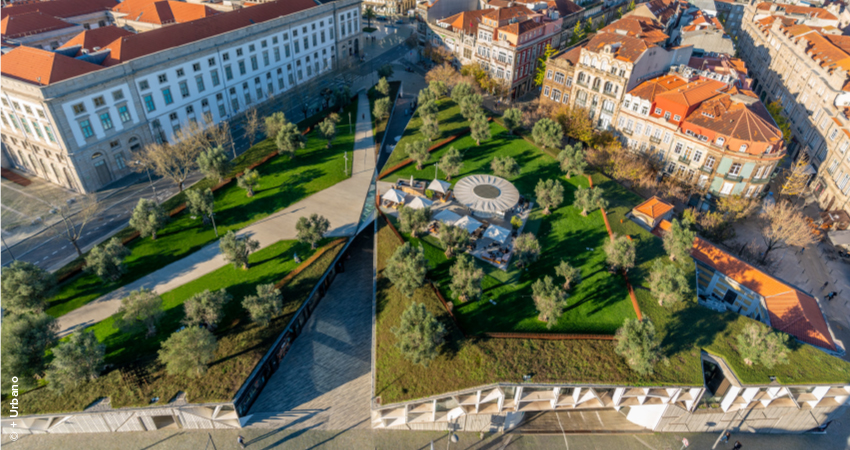
The project that revitalized Praça de Lisboa, in downtown Porto, was called Passeio dos Clérigos. Combining commerce, leisure, and respect for the heritage importance of the surroundings in an outdoor space that includes a green area on the roof was the way to reclaim this area as a meeting point for the city. A project completed in 2013 by a company from the Horto do Campo Grande group, which we are proud to maintain.
Establishing an open relationship with the city was the idea that defined the Passeio dos Clérigos project. The process, completed in 2013, returned one of the prime areas of the Invincible City to the public.
Designed by the Balonas & Menano Architecture Office, the project proposed a new layout for Praça de Lisboa, formerly known as Mercado do Anjo, with a unique form driven by the need to create interior spaces (existing parking and commercial areas) that would relate dynamically to the surroundings.

Ensuring Dynamism and Inviting Use
In this regard, “one of the key points of the proposal was to offer a passage consistent with the surroundings, enhancing it, useful, functional, and without barriers or obstacles, becoming a natural passage/route.” And so a pedestrian passage emerged that embraces the concept of street commerce. Establishments in the areas of dining, fashion, and leisure make up the commercial offering defined for this open-air route, providing shade or shelter from the rain, and directly connecting the two iconic locations of the square: the Clérigos Tower and Livraria Lello.
To ensure mobility, convenience, and comfort, the project also maintained the existing underground car parking and equipped the pedestrian commercial route with partial protection, providing shelter in winter and shade in summer for passersby and visitors moving through the space.
But because the concept is one of complete experience, a green area of 4,500 square meters was added to the commercial area, functioning as a living roof over it.
Green Roof
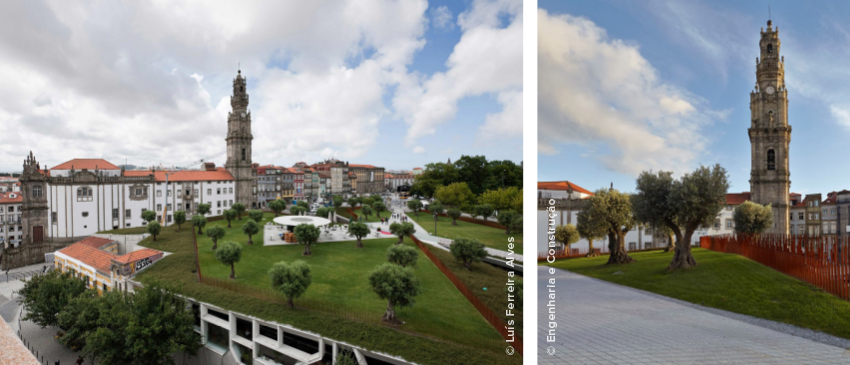
In this landscaped area, whose execution was carried out by a company from the Horto do Campo Grande group, the highlight goes to the centuries-old olive trees, whose trunks appear as true living sculptures. “The roof finish, essentially green, gave rise to a suspended garden punctuated by trees in the heart of the city, giving the whole a landscape character. The choice of olive trees evokes the memory of the old Porta do Olival. A large part of the roof area is accessible, with paved areas in gray granite slats,” notes the designer.
The fifty trees that punctuate the vast lawn attract the gaze and lenses of passersby, inviting them to stop and enjoy this piece of nature in the city. Besides adding a dimension of leisure and well-being to the location, this garden brings environmental benefits on several levels. Being a “green roof” over the commercial area, it affects comfort inside the building, moderating temperature extremes, reducing energy consumption, and also improving acoustic insulation. On a city scale, the solution contributes to increased biodiversity, improved air quality, and mitigation of the “heat island” effect common in urban centers.
Base Porto: More Than a Garden
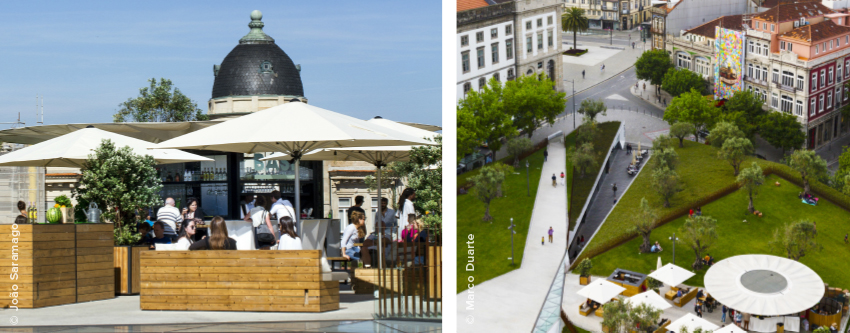
In 2015, Base Porto arrived at the Clérigos Garden. “By nature we are sun, sky, moon, grass, and trees. By the city we are architecture, lights, movement, fascination, and seduction.” That’s how they define themselves. With a privileged view over the city of Porto, Base Porto is a space where there is always room for joy, friends, and lots of music. It is intended for those seeking to unwind and relax at any time, while enjoying a drink or cocktail and tasting one of the snacks, which are prepared in partnership with the Clérigos restaurant. Besides this, it’s also worth taking advantage of the events they organize.
The project resulted in a renewed and revitalized Clérigos Garden, which preserves the city’s history and has become a leisure space for locals and visitors in the heart of Porto.
Maintenance by Horto do Campo Grande
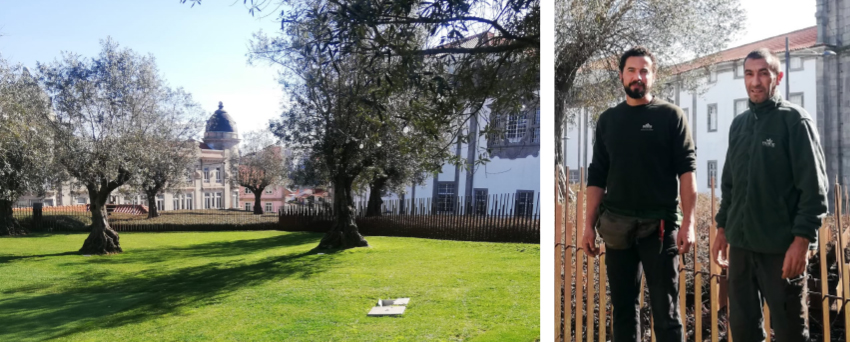
Carlos Ferreira and Filipe Barbosa are the visible face of HCG in the North. In addition to a series of other interior and exterior maintenance projects, they maintain this incredible and highly sought-after space in the center of Porto.
What is it like to maintain a space so popular with both locals and visitors, and where, besides coming to “have a drink with friends,” people attend concerts or take advantage of the view when visiting Livraria Lello right next door?
It’s a challenge. Keeping the space clean and well-maintained requires constant vigilance and attention so that people feel this garden is valued and treated with care and can enjoy the best it has to offer.
Since the initial garden project, has there been any major change or adjustment that has been made?
Actually, yes. The originally envisioned project included a glass fence along the exterior. However, with the planned changes, the lawns had to be reduced to create planting beds, which besides their aesthetic function, also have an important protective function, requiring a revision of the irrigation system as well.
Considering the plant species present in the garden, which do you consider the most demanding?
The plants in the beds need to be trimmed and cared for to stay beautiful. The olive trees are reproductive, so pruning must meet that requirement.
How do you keep the lawn aesthetically pleasing, given the number of people using the garden?
That’s one of the big challenges! To do this, we fertilize the garden, especially in March or October, and replace the turf, usually once a year.
Regarding the irrigation system, what are the requirements?
People tend to break the irrigation nozzles, which requires extra attention on our part to replace damaged parts to ensure the system functions properly.
© Companhia das Cores for Horto do Campo Grande