
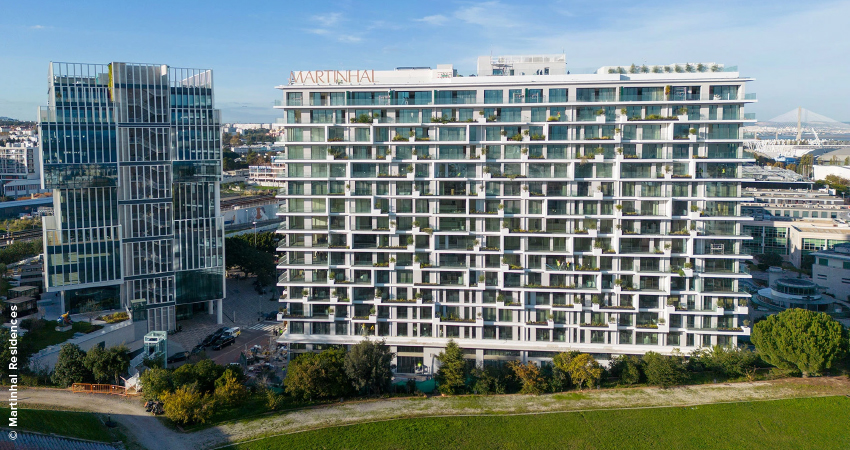
Owned by the award-winning Elegant Group, which includes Martinhal Family Hotels & Resorts, specialists in luxury family experiences, Martinhal Residences, designed by internationally renowned architect Eduardo Capinha Lopes, is a premium contemporary development offering comfortable, elegant, and modern apartments. It combines magnificent amenities with Martinhal’s excellent services for luxury family living in a modern area of Lisbon, Parque das Nações.
Landscaping project and its execution
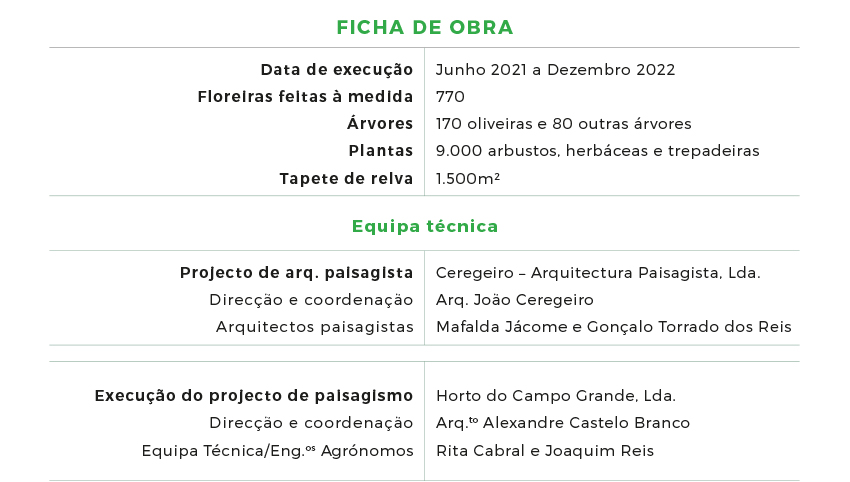
The landscaping project, designed by the firm Ceregeiro – Arquitectura Paisagista, Lda., encompasses all outdoor spaces—located at different points in the building and throughout the area surrounding the plot, which in turn integrates into the overall architectural project—and was fully executed by Horto do Campo Grande.
The landscaping project classified the intervention area by sectors, identifying the climatic and microclimatic characteristics in each one, establishing a direct correlation between the selected species and the availability of soil over slabs. The proposed plant selection is representative of the geographic/bioclimatic context—native plants associated with ornamental species—and took into account their compatibility, growth, and dominance of neighboring species, aiming for less demanding maintenance. All planted areas were equipped with a drip irrigation network for sustainable water management, as well as drainage networks, ensuring a beautiful and healthy garden. HCG was the company responsible for executing all landscaping work.
Planters and beds
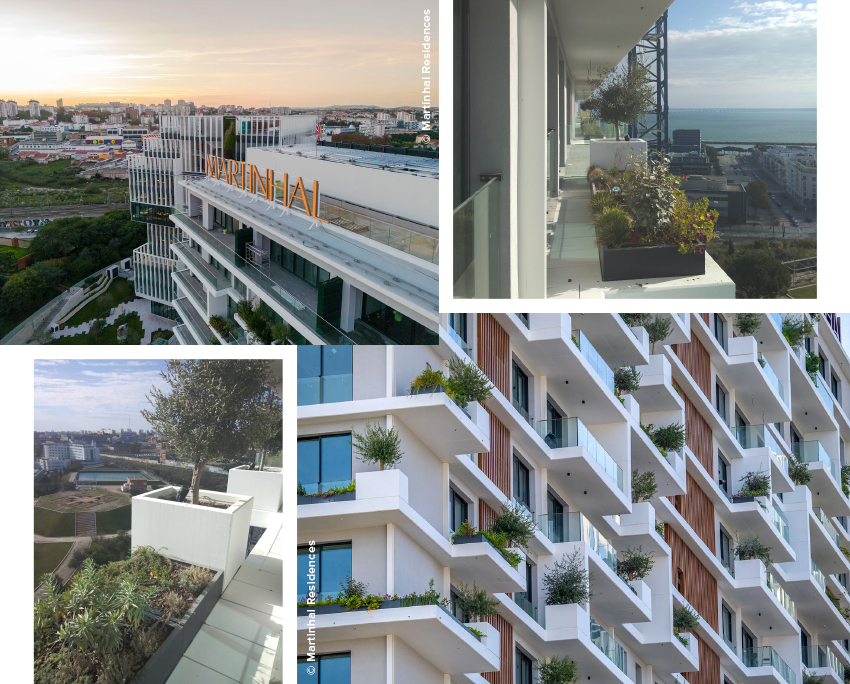
The building is characterized by its modular geometry, present in the different protrusions on the facades, balconies, where the sets composed of planters and beds stand out. These sets are distributed along each floor (from floor 2 to 14), without dimensional uniformity and without relationship between floors, introducing a “random” effect to the facades, which the vegetation reinforces.
Each set has at least one planter, where an Olive tree (Olea europaea) of reduced size with an already formed trunk was installed (installed with a fixing system—anchoring). In turn, the bed, with a concrete base, was extended with a sheath of about 35 cm, composed of a set of several boxes (to achieve better handling and pest control in the soil), arranged according to their location in the building (facade), where after being properly lined with geotextile fabric, the substrate for fixing the different plants was placed. This way, we managed to have the planter with the Olive tree and the bed with herbaceous, shrub, and sub-shrub species. With a central shrub occupation, an herbaceous and grass covering on the dwelling side, and an herbaceous cover with the capacity to cascade on the outside (facade), maintaining low-density occupations and leaving openings from the openings. The rhythm of growth and evolution will be monitored by the HCG maintenance team to prevent crown growth beyond the fixing support capacity of the species.
The boxes that make up the various planters (a total of 770) were all built in the Horto do Campo Grande workshops, in galvanized sheet metal and painted with anti-corrosion paint and matte finish, a lightweight material (which does not increase the load on the balcony) and resistant. Their interior was properly insulated with fiberglass and resin (a technique developed and tested in HC – Horto Collection products), and placed on site using hoists. They were all equipped with a drainage system to ensure the healthy development of the plants.
At the bottom of the planters, a metal grill was added to facilitate the internal drainage of excess water (soil drainage).
Each floor of the building includes an automatic irrigation management point. Two irrigation systems were installed for the balconies: the planters (Olive trees) with root irrigation, and the beds (Shrubs) with drip irrigation, both integrated into the same process.
The execution of this distinctive project had an added difficulty due to the individuality that each planter + bed set presents, overcome by the experience acquired over the years by the custom products department of the HCG workshops. All its installation required rigorous planning, due to the need for correspondence of the pieces produced for specific floors and apartments, and also due to accessibility conditions, the height of the building and platforms. Most of the work was carried out using cranes and hoists, with personnel movement on scaffolding and through the immense staircase up to floor 15, following strict safety protocols.
This will be followed by demanding and unconventional maintenance, done through suspended platforms (using structures suspended on the facade), since most of the planters contact balcony openings located on the different facades of the building.
Vertical gardens
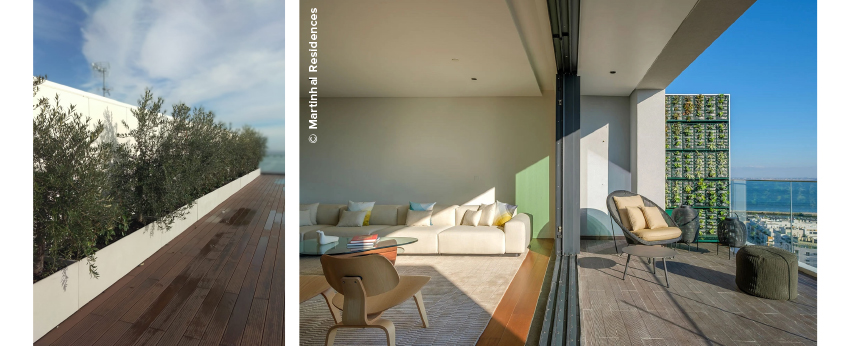
Several additional works were developed, adding value to the project, namely 12 natural vertical gardens that serve as dividing walls on the penthouse balconies on floor 14, as well as planting of Olive trees and shrubs on the rooftop (floor 15), the future common leisure area of the building.


Surrounding area
From December (2021), work began in parallel in the surrounding area, consisting of landscaping six enormous concrete platforms next to the Cabeço das Rolas garden, with lawn carpet and planting of trees and shrubs in beds.
Discover some of the plants selected for this project
Planters and beds – Olive tree – Olea europaea, Myrtle – Myrtus communis, Hibiscus – Hibiscus rosa sinensis, Laurustinus – Viburnum tinus, Rose sp;
Rooftop – Olive tree – Olea europaea, Silverberry – Elaeagnus pungens
Surrounding area – Lawn carpet, Cherry plum – Prunus cerasifera, Wild olive – Olea sylvestris, Plumbago – Plumbago capensis, Ivy – Hedera helix, Boston ivy – Parthenocissus tricuspidata, Asparagus – Asparagus.
© Companhia das Cores for Horto do Campo Grande