
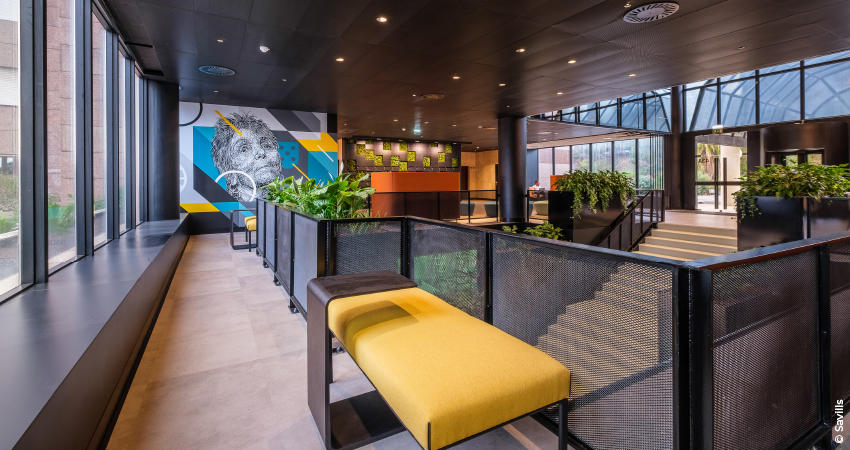
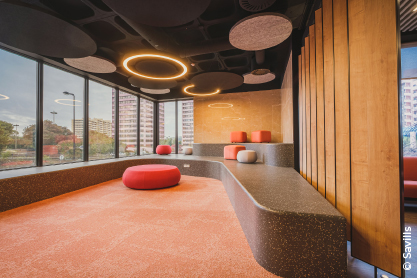
Modernizing and revitalizing the impressive entrance floor with new features and environments formed the basis of Savills’ work for the conversion of the common areas of the charismatic Green Park Building in Lisbon. Horto do Campo Grande was part of this project in which interaction with nature was prioritized, in the selection and implementation of the most suitable plants for the interior spaces.
Near Praça de Espanha, in a prestigious area of Lisbon, stands the Green Park building. With over 62,000m² of construction area, this complex combines an exclusive residential zone with office and retail areas. Due to its urban setting and distinctive architectural design, Green Park is one of the capital’s recognized developments that mark the city. However, after successive interventions, the imposing Lisbon building had become uncharacteristic and out of step with modern times and new trends.
Taking advantage of its enormous potential, with regard to its generous areas and spatial and construction qualities, Savills’ architecture team developed a project with the aim of “modernizing the common spaces, implementing new living, working and leisure areas, enhancing the underlying architectural characteristics, the noble language, spacious areas and generous ceiling heights of the building,” they explain.

Modernization & New Concepts
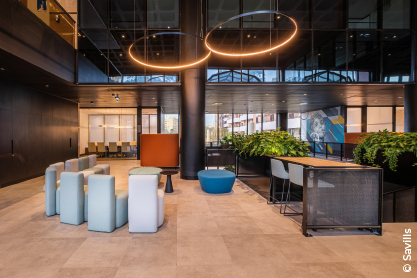
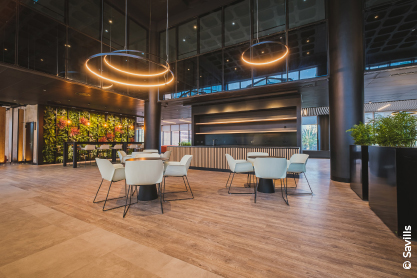
The main idea was based on the intention to transform the entrance floor into something more than a “simple” reception. “We sought to revitalize this large area of approximately 1,000m² through the introduction of various features and new environments.” In the new space distribution, “the position of the reception was redefined in the center of the open space, with suspended ivy and lighting fixtures, which gave new life to this fantastic 20-meter-high ceiling, previously forgotten and underutilized.”
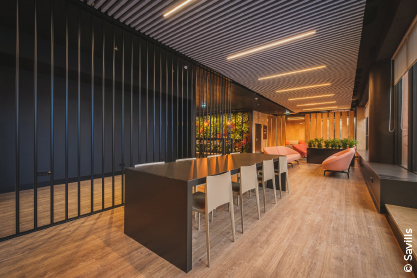
In addition to a new reception, the removal of the old planters and deactivated artificial ponds “gave way to lounge areas and the implementation of the WorkCafé concept, in a total redefinition of functions in the new open space,” they tell us, emphasizing that this new concept was “designed to be an area that allows for light meals, enjoying a break, or even quick meetings.”
Alongside these areas, two small amphitheaters for informal presentations, three meeting rooms, and lounge and informal work areas were designed.
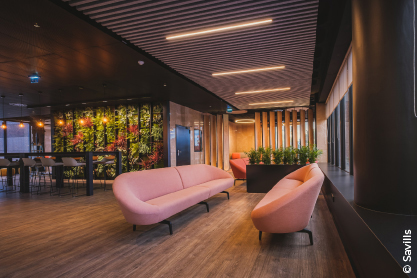
The project was developed “based on the industrial concept; the nobility and sober aesthetics of the building were preserved and, simultaneously, complemented with more contemporary details.” To achieve this, they chose to include, in a selective way, some color and natural elements, such as wood and plants.
Now, in place of a former hall with an austere atmosphere, there is a spacious and modern space where you want to be.
The power of plants in the “Green Park Building” project
With a view to more prolonged use of these spaces, which open in an invitation to enjoy a break in a comfortable environment, Savills chose to place several plants that “bring life, comfort and well-being to the space,” they tell us, explaining that “these green areas are embodied as sculptural elements that evoke nature in the built space, as elements of complementarity between the interior and exterior space, and of enhancing the view system to the outside, but also as delimiting elements between spaces that favor the seclusion of the remaining areas, without ever imposing a restrictive visual break.” This was everything that Savills’ project brought to the new common areas of the Green Park Building, where Horto do Campo Grande was involved.
Horto do Campo Grande’s proposals
“Provide the space with a sense of freshness, using typical indoor plants, adapted to our climate, that awaken the senses, arouse curiosity on the part of the user and make the spaces more inviting and creative” – Savills
From the analysis of the project developed by Savills and in particular the location of the planters and plants, Horto do Campo Grande proposed a selection of species that would best adapt to the different environments of the common areas and that would meet the objectives established for the spaces.
Vera Quintas, from the Horto do Campo Grande team and responsible for monitoring the project, explains that the choice was made based on the solar orientation of the different spaces, the existence of natural light and its intensity. The aesthetic and functional aspect was also an important point to consider in the selection of plants, always opting for those that worked best visually in each location.
“For the planters where we were asked for ‘light vegetation,’ we chose to place only Chamaedorea elegans, so that its simplicity and elegance would contrast with a more fun and varied ‘mix’ of plants, with different sizes, shapes and colors, present in the remaining planters.”
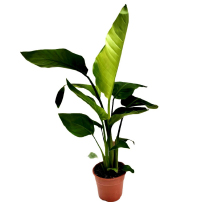
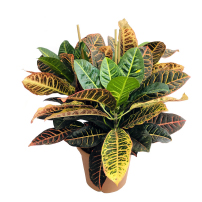
Attentive to the sun exposure of each location defined by Savills for placing the plants, we chose to combine Strelitzias Nicolai, with exuberant green foliage that stand out in any space, with the exotic Croton Petras, the Dypsis Lutescens, better known as Arecas, and the famous and resistant Snake Plants. In the other planters, with less sun exposure, we chose to combine Calatheas Ornatas, Peace Lilies and Zamioculcas Zamifolias, with the Snake Plants and Chamaedorea Elegans present in the other planters, “to create greater visual harmony.”
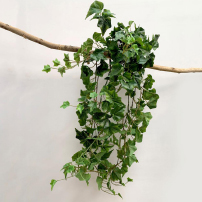
In the staircase area, the choice was to combine the versatile Philodendron Xanadu with bright green leaves, with Hedera Ivy. Finally, for the decoration of the suspended lighting fixtures, artificial ivy was used.
Discover the plants in this project


(Dypsis Lutescens)
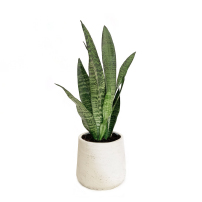
(Sansevieria)
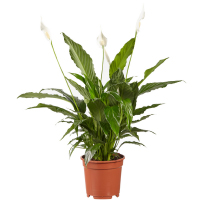

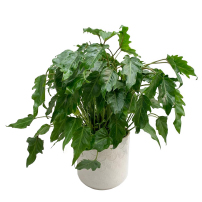
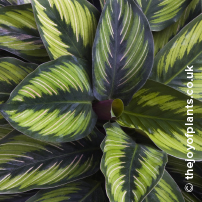

© Horto do Campo Grande
Planters, Project, Green Park, Architecture, Design, Plants, Plant Styling, Chamaedorea elegans, Croton petra, Dypsis lutescens, Sansevieria trifasciata laurenti, Strelitzia nicolai, Spathiphilium, Zamioculca zamifolia, Calathea ornata