

The Palácio de Palhavã embodies all the architectural grandeur and artistic aura of an imposing 17th-century manor house. Its walls perpetuate stories and, in every corner, you can feel the whispering of the many influences that, over time, have enriched its artistic legacy. The palace is currently the official residence of the Spanish Ambassador to Portugal.
Brief historical background
The construction of the Palácio de Palhavã, on the estate of the same name located in the parish of São Sebastião da Pedreira in Lisbon, dates back to 1660, commissioned by the 2nd Count of Sarzedas, D. Luís Lobo da Silveira. The palace was thus built in a rural area near the historic centre, known at the time as the Palhavã site, and served as the Sarzedas family residence for many years. The eldest son, D. Rodrigo da Silveira, was the main driving force behind the completion of the palace, particularly the haughty noble portal where the Sarzedas coat of arms could be identified.
Until 1918, when the palace was acquired by the Spanish Government as the official residence for the Spanish Ambassador, the Palácio de Palhavã was the scene of successive occupations, mostly by noble families. Notable residents after the Sarzedas (1668-1747) included the “Meninos da Palhavã” (1747-1760 / 1778-1801) and the Counts of Azambuja (from 1860). Underlying each transition through the palace is a mix of influences, and many changes were made to its contents, namely restoration works that made their mark. But nothing altered its grandeur and symbolism, and today, this palace and its gardens continue to be synonymous with prestige and charm.

Main periods of palace occupation
As the 4th Countess of Sarzedas died in 1747 without direct descendants, the Quinta de Palhavã and the assets of the House of Sarzedas were inherited by D. Francisco Xavier de Menezes, 6th Count of Ericeira and 2nd Marquis of Louriçal, who was married to the daughter of the 2nd Count of Sarzedas. In that same year, the Quinta de Palhavã was leased to become the residence of the three illegitimate sons of King D. João V – D. António, D. Gaspar, and D. José – who became known as the “Meninos da Palhavã” (the Boys of Palhavã). This period of occupation covers two moments. The first lasted until 1760, when the boys were exiled to Buçaco by order of the Marquis of Pombal, and a second marked their return between 1778 and 1801.
In 1833, during the Liberal Wars, the House suffered a violent attack that left it heavily damaged. The property remained in a precarious state until 1860, when the 3rd Count of Azambuja acquired the estate and palace on the occasion of his marriage and began an extensive plan of improvement and restoration work under the responsibility of Possidónio da Silva, architect to the Royal House. The remodeling of Palhavã should be considered a large-scale intervention that benefited all rooms and quarters through the replacement of interiors and the good taste and richness of the materials used, giving rise to an artistic language that remains to this day without significant changes.
It was also during this period of Palhavã’s recovery that the coat of arms, still visible today, was placed at the top of the noble portal that gives access to the residence’s main courtyard. On the back of the coat of arms, the letter A of the Azambuja family can be seen.
In the Azambuja era, Palhavã was recognised as one of the most refined stages of Lisbon society, hosting some of the most praised balls and parties.
In this majestic palace, where the counts’ eleven children were born, the Count of Azambuja would pass away in 1914, an event that marked the end of an era.
In 1918, Francisco de Almeida Grandella, an influential businessman, bought the estate and palace from the heirs of the Count of Azambuja. Meanwhile, the Spanish Government showed interest in acquiring a dignified residence for diplomatic occupation, and the choice fell on the Palácio de Palhavã. Francisco de Almeida Grandella agreed to sell the property, though by then a large part of the surrounding grounds had been excised, where the Bairro Azul would be built in the 1930s.
The year 1936 marked the largest remodeling project of the palace after its acquisition by the Spanish State, with architect Pedro Muguruza Otaño responsible for the project.
Later, following the acts of vandalism in 1975, the palace inevitably became the subject of new restorations. By the time of the first State visit to Portugal by King Juan Carlos I and Queen Sofia in 1978, the Palácio de Palhavã had already regained the splendour and opulence that have always characterised it. Today, all its rooms share the same beauty, comfort, and artistic richness, serving as an invitation to relive the history of times past.
Historic gardens – the landscape as a witness
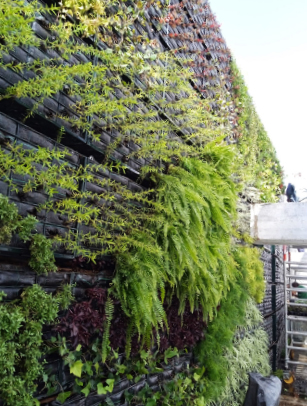
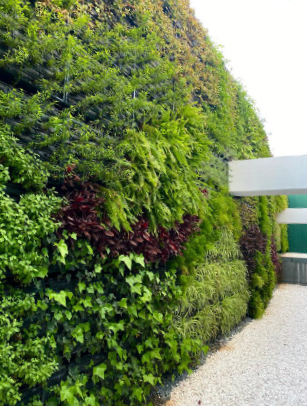
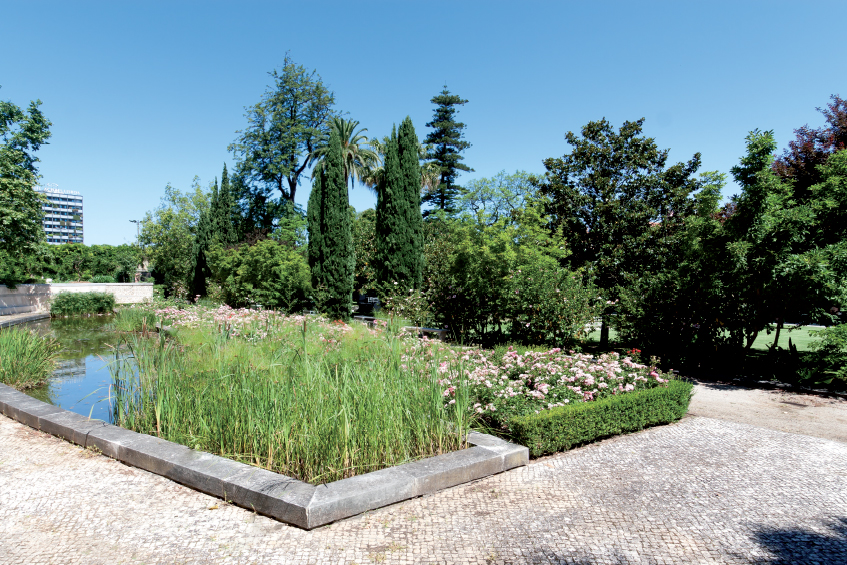
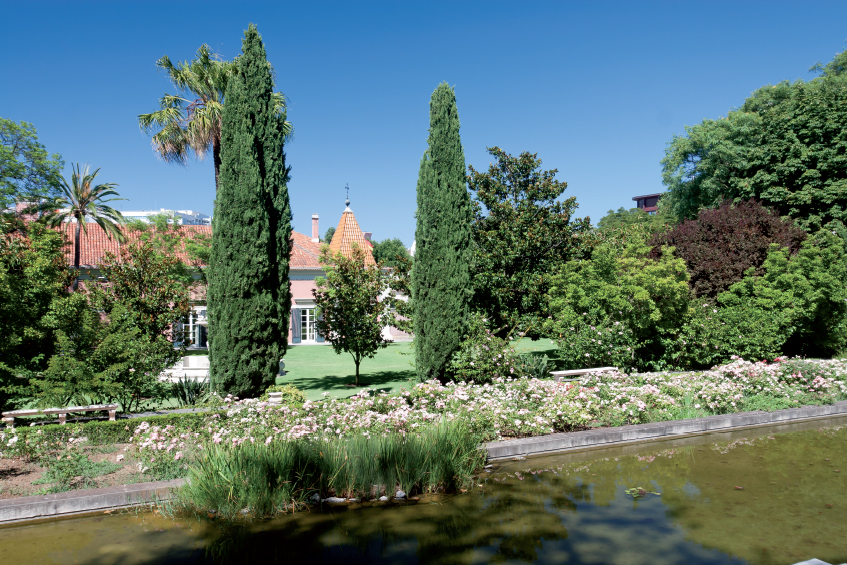
The intervention of the architects hired for the various conservation works on the property and the interest shown by the palace’s various occupants in the art of botany were clearly present in the enrichment that the palace’s majestic green spaces witnessed over time. Alongside the diversity of vegetation, the sculptural groups—whose location does not seem to have changed over the centuries—are undoubtedly among the elements that have contributed most to the artistic enrichment and recreational value of these green spaces typical of grand stately residences. The fountains, with statues mostly alluding to mythological figures, were largely commissioned from foreign sculptors who drew inspiration from the artistic influences of their respective eras. Even today, these fountains, loaded with symbolism, are true works of art that lend an aura of grandeur to the palace gardens.
“The Palácio de Palhavã continues to serve its representational purposes,
gaining in the new millennium an awareness of its architectural identity
and of a historical memory dating back to the 17th century”
art historian José de Monterroso Teixeira, in “The Palácio de Palhavã – Architecture and Representation”.
The standardisation of the tree canopy across the three levels of the garden has restored a new visual balance, allowed for greater natural light, and highlighted the century-old trees that frame the space—such as Palms, Jacarandas, Magnolias, and a magnificent Horse Chestnut—bringing a new life to this area.
The wide and well-kept lawn, which often hosts embassy parties and events, is flanked by flowerbeds where various species of flowers—roses and hydrangeas—plants like bird of paradise, and shrubs coexist harmoniously. With a drip irrigation system and the daily, attentive care of the gardening team, all species bloom healthily and harmoniously, serving to create beautiful floral and decorative arrangements found displayed in the palace’s magnificent rooms.
Information source:
Album “The Palácio de Palhavã – Architecture and Representation”, with texts by José de Monterroso Teixeira and photography by Laura Castro Caldas and Paulo Cintra; published by the Embassy of Spain in 2008.
More than three centuries after the construction of the Palácio de Palhavã, there is much to be said about its historical identity and architectural and artistic expression. Reading this album and contemplating the photographic images that illustrate it are an irresistible invitation to gain a deep and authentic understanding of its historical and artistic evolution.